Direct Bookings
The 10-Step Guide to Boosting Direct Bookings for Boutique Hotels
The 10-Step Guide to Boosting Direct Bookings for Boutique Hotels
The 10-Step Guide to Boosting Direct Bookings for Boutique Hotels
byeHotelier
7 min

How independent and boutique hotels can win back bookings from the OTAs, and keep the commission.
Every booking that comes through Expedia, Booking.com or Airbnb costs you. Not just the 15–25% commission, but the relationship with your guest, the data, and the chance to tell your own story. For a boutique hotel, that lost margin is the difference between a good year and a great one.
The good news: guests want to book direct. They just need a reason, and a booking experience that feels as effortless as the apps they already use. Here are ten steps to make your own website the easiest, most compelling place to book.
1. Put your reasons to book direct in the hero
The single most valuable pixels on your website are the ones a guest sees first, before they scroll, before they get distracted, before they open a new tab to price-check on an OTA. Use them. Your hero section should state, plainly, why booking direct is the smart choice:
Best rate guarantee, so you’ll never pay less anywhere else
Free breakfast for direct bookers
Free parking
Flexible cancellation, room upgrades, late checkout, whatever you can offer
Don’t bury these on a separate “Offers” page. If a guest has to hunt for the reason, they’ll assume there isn’t one and head back to the OTA out of habit.
2. Embed the booking engine natively, with no link-off
The fastest way to lose a booking is to send the guest somewhere else to complete it. Every redirect to a third-party checkout introduces doubt: a new domain, an unfamiliar layout, a moment to wonder whether this is safe. That hesitation is where bookings die.
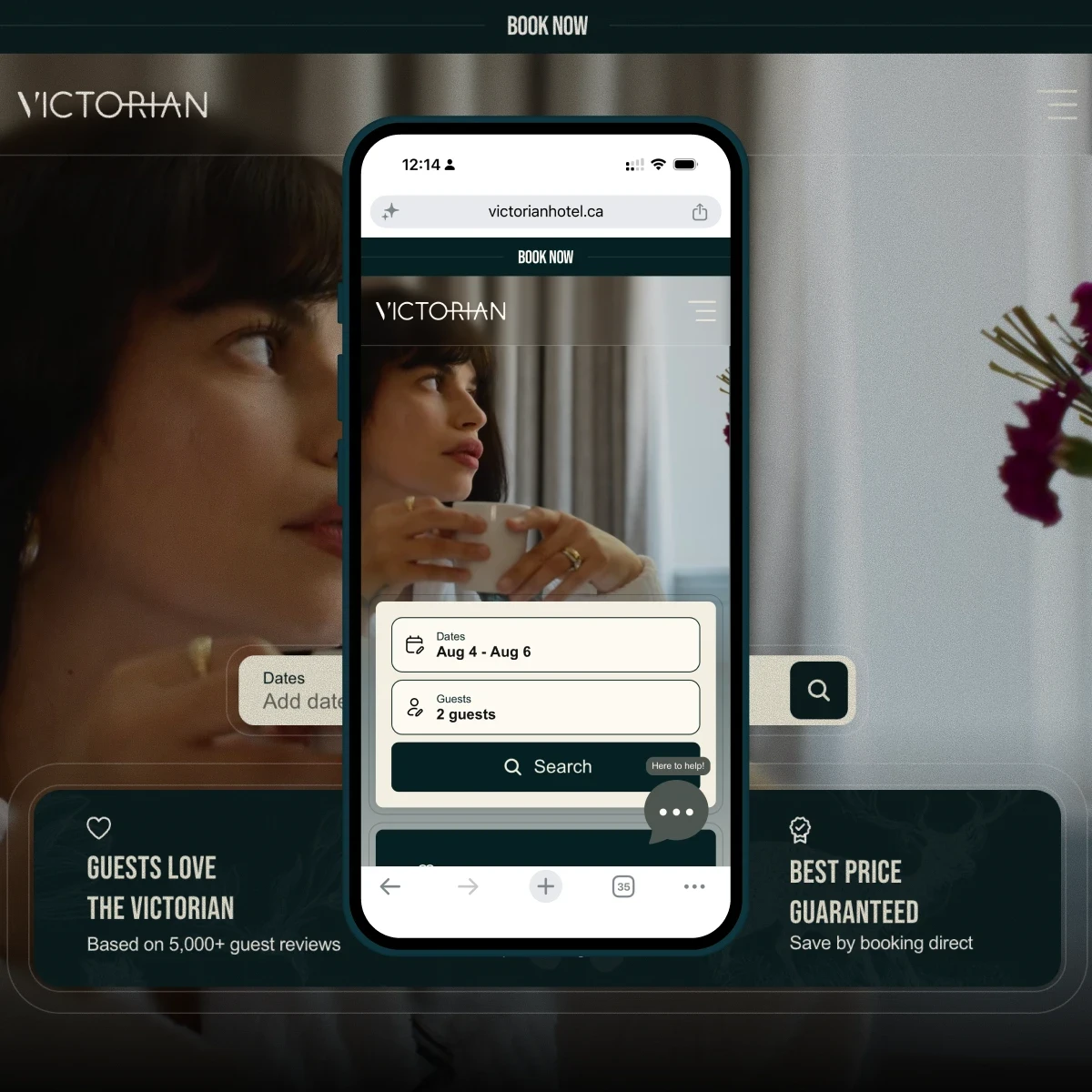
Instead, embed your booking engine natively, directly in the page. We build the Mews booking engine (or booking engine of the hotel’s choice) straight into the hotel’s own site so guests search availability, pick a room and pay without ever leaving. It looks and feels like part of the hotel’s brand, guests book with confidence, and because it’s direct, the hotel pays zero commission. You can see this in action on some of the sites we’ve built:
3. Benchmark your booking flow against the OTAs, honestly
Here’s an uncomfortable exercise: open your own website on your phone and try to book a room. Then do the same on Expedia or Booking.com. Which one felt better?
If the honest answer is the OTA, you’re losing direct bookings. Full stop. Guests are trained by Expedia, Booking.com and Airbnb to expect a fast, frictionless, thumb-friendly flow. When your own site feels slower or clunkier, they’ll default to the channel that feels easy.
4. Design mobile-first, because expectations are higher than ever
The majority of travel research, and a growing share of booking, happens on a phone. Mobile isn’t a scaled-down version of your desktop site; it’s the main event. Every element of the booking journey needs to work with one thumb: date pickers that are easy to tap, room cards that load instantly, a checkout that doesn’t demand pinching and zooming.
The OTAs have spent billions perfecting this. You don’t need billions. You need a site and a booking engine that are built mobile-first from the ground up, so the experience is at least on par with the apps your guests already trust.
5. Bring your guest reviews on-site, don’t send guests away to read them
Reviews are the moment of truth in the booking decision. But if the only way to read them is a link out to TripAdvisor or Google, you’ve just handed the guest an exit, and a page full of competitors’ ads.
Embed your reviews directly on your site instead. Let guests see the social proof they need without ever leaving the page or breaking the booking flow. It keeps them in your world, reinforces trust at exactly the right moment, and removes one more reason to bounce back to an OTA.
6. Show the real experience with embedded Instagram and social signals
Boutique hotels sell an experience, not just a room, and nothing conveys that better than real, current imagery. Embedding your Instagram feed directly on your site lets guests connect authentically with your brand and see the genuine experience: the light in the rooms, the breakfast, the neighbourhood, the details that make you different.
Combined with your embedded reviews, these social signals build the trust that turns a browser into a booker. This is the layer an OTA listing simply can’t replicate. It’s standardised, and you are not.
7. Make your best-rate promise unmissable, and honour it
A best rate guarantee only works if guests actually see it and believe it. State it clearly near the booking widget and in the hero, so the guest never feels the need to open another tab to check. When people trust that direct is the best price, price-shopping stops being a reflex.
8. Bundle perks only direct guests get
Rate parity rules can limit how low you go on price, but they don’t stop you adding value the OTAs can’t. Free breakfast, complimentary parking, a welcome drink, early check-in, a room upgrade when available: these cost you little but shift the maths firmly in favour of booking direct. Make them exclusive to direct bookings and say so.
9. Strip out every point of friction
Count the taps between landing on your homepage and confirming a booking. Then cut that number down. Fewer form fields, no forced account creation, clear pricing with no surprises at the final step, and a payment process that feels secure and familiar. Every extra click is a chance for the guest to reconsider, and the OTAs have made “book in three taps” the standard you’re measured against.
10. Own your brand, the one thing an OTA can never copy
This is where boutique hotels win. An OTA listing is a template: the same layout, the same fonts, the same photo grid as ten thousand other properties. Your own site is a blank canvas. Once your booking experience is on par with the OTAs, your brand, your story and your differentiated offers make it more compelling. That combination of frictionless booking plus a distinctive, trustworthy brand is what converts a guest who was about to book on Booking.com into a guest who books with you.
The bottom line
Winning direct bookings isn’t about tricking guests away from the OTAs. It’s about giving them a genuinely better experience: a native, commission-free booking engine, a mobile-first flow that rivals the apps they already use, reviews and social proof right where they need them, and clear reasons to book direct front and centre. Match the OTAs on ease, then beat them on brand, and the commission stays where it belongs.
Every hotel site we build at byeHotelier is designed to do exactly that. Take a look at The Wesley, The Victorian Hotel and Meander to see these principles in action.
How independent and boutique hotels can win back bookings from the OTAs, and keep the commission.
Every booking that comes through Expedia, Booking.com or Airbnb costs you. Not just the 15–25% commission, but the relationship with your guest, the data, and the chance to tell your own story. For a boutique hotel, that lost margin is the difference between a good year and a great one.
The good news: guests want to book direct. They just need a reason, and a booking experience that feels as effortless as the apps they already use. Here are ten steps to make your own website the easiest, most compelling place to book.
1. Put your reasons to book direct in the hero
The single most valuable pixels on your website are the ones a guest sees first, before they scroll, before they get distracted, before they open a new tab to price-check on an OTA. Use them. Your hero section should state, plainly, why booking direct is the smart choice:
Best rate guarantee, so you’ll never pay less anywhere else
Free breakfast for direct bookers
Free parking
Flexible cancellation, room upgrades, late checkout, whatever you can offer
Don’t bury these on a separate “Offers” page. If a guest has to hunt for the reason, they’ll assume there isn’t one and head back to the OTA out of habit.
2. Embed the booking engine natively, with no link-off
The fastest way to lose a booking is to send the guest somewhere else to complete it. Every redirect to a third-party checkout introduces doubt: a new domain, an unfamiliar layout, a moment to wonder whether this is safe. That hesitation is where bookings die.
Instead, embed your booking engine natively, directly in the page. We build the Mews booking engine (or booking engine of the hotel’s choice) straight into the hotel’s own site so guests search availability, pick a room and pay without ever leaving. It looks and feels like part of the hotel’s brand, guests book with confidence, and because it’s direct, the hotel pays zero commission. You can see this in action on some of the sites we’ve built:
3. Benchmark your booking flow against the OTAs, honestly
Here’s an uncomfortable exercise: open your own website on your phone and try to book a room. Then do the same on Expedia or Booking.com. Which one felt better?
If the honest answer is the OTA, you’re losing direct bookings. Full stop. Guests are trained by Expedia, Booking.com and Airbnb to expect a fast, frictionless, thumb-friendly flow. When your own site feels slower or clunkier, they’ll default to the channel that feels easy.
4. Design mobile-first, because expectations are higher than ever
The majority of travel research, and a growing share of booking, happens on a phone. Mobile isn’t a scaled-down version of your desktop site; it’s the main event. Every element of the booking journey needs to work with one thumb: date pickers that are easy to tap, room cards that load instantly, a checkout that doesn’t demand pinching and zooming.
The OTAs have spent billions perfecting this. You don’t need billions. You need a site and a booking engine that are built mobile-first from the ground up, so the experience is at least on par with the apps your guests already trust.
5. Bring your guest reviews on-site, don’t send guests away to read them
Reviews are the moment of truth in the booking decision. But if the only way to read them is a link out to TripAdvisor or Google, you’ve just handed the guest an exit, and a page full of competitors’ ads.
Embed your reviews directly on your site instead. Let guests see the social proof they need without ever leaving the page or breaking the booking flow. It keeps them in your world, reinforces trust at exactly the right moment, and removes one more reason to bounce back to an OTA.
6. Show the real experience with embedded Instagram and social signals
Boutique hotels sell an experience, not just a room, and nothing conveys that better than real, current imagery. Embedding your Instagram feed directly on your site lets guests connect authentically with your brand and see the genuine experience: the light in the rooms, the breakfast, the neighbourhood, the details that make you different.
Combined with your embedded reviews, these social signals build the trust that turns a browser into a booker. This is the layer an OTA listing simply can’t replicate. It’s standardised, and you are not.
7. Make your best-rate promise unmissable, and honour it
A best rate guarantee only works if guests actually see it and believe it. State it clearly near the booking widget and in the hero, so the guest never feels the need to open another tab to check. When people trust that direct is the best price, price-shopping stops being a reflex.
8. Bundle perks only direct guests get
Rate parity rules can limit how low you go on price, but they don’t stop you adding value the OTAs can’t. Free breakfast, complimentary parking, a welcome drink, early check-in, a room upgrade when available: these cost you little but shift the maths firmly in favour of booking direct. Make them exclusive to direct bookings and say so.
9. Strip out every point of friction
Count the taps between landing on your homepage and confirming a booking. Then cut that number down. Fewer form fields, no forced account creation, clear pricing with no surprises at the final step, and a payment process that feels secure and familiar. Every extra click is a chance for the guest to reconsider, and the OTAs have made “book in three taps” the standard you’re measured against.
10. Own your brand, the one thing an OTA can never copy
This is where boutique hotels win. An OTA listing is a template: the same layout, the same fonts, the same photo grid as ten thousand other properties. Your own site is a blank canvas. Once your booking experience is on par with the OTAs, your brand, your story and your differentiated offers make it more compelling. That combination of frictionless booking plus a distinctive, trustworthy brand is what converts a guest who was about to book on Booking.com into a guest who books with you.
The bottom line
Winning direct bookings isn’t about tricking guests away from the OTAs. It’s about giving them a genuinely better experience: a native, commission-free booking engine, a mobile-first flow that rivals the apps they already use, reviews and social proof right where they need them, and clear reasons to book direct front and centre. Match the OTAs on ease, then beat them on brand, and the commission stays where it belongs.
Every hotel site we build at byeHotelier is designed to do exactly that. Take a look at The Wesley, The Victorian Hotel and Meander to see these principles in action.
Recent posts
Recent posts
Recent posts
Ready to boost your direct bookings?
Book a call to see how byeHotelier can elevate your property today.